The modernisation of public services provided to citizens and the continuous improvement of their quality are priorities of the Public Services Agency, which has been undergoing an active transformation process in recent years.
With the launch of negotiations on the accession of the Republic of Moldova to the European Union, the PSA is the first public institution in the Republic of Moldova to assume responsibility for applying European standards in the field of quality management. In this regard, the CAF model (Common Assessment Framework), a European quality management tool designed specifically for public institutions, will be applied.
From 01 to 04 July 2024, experts Tihana Puzić (Deputy Director of the European CAF Resource Centre at EIPA) and Nick Thijs (OECD/SIGMA expert) paid a working visit to the Public Services Agency to present the CAF model (Common Assessment Framework) and analyse opportunities for its implementation within the Agency. The activity takes place within the framework of the project “Re-engineering Public Services in Eastern Partnership Countries”, implemented by the German Agency for International Cooperation (GIZ), with financial support from the German Federal Ministry for Economic Cooperation and Development (BMZ) and in partnership with the SIGMA Programme, a joint initiative of the OECD and the EU, funded by the European Union.
PSA Director Mircea Eșanu appreciated the support provided by the development partners of the Republic of Moldova and expressed his openness to applying European standards in the field of quality management within the institution, in order to continuously improve the services provided to citizens and ensure transparency and efficiency in the use of public resources. “The successful implementation of the CAF model at the Public Services Agency will make an essential contribution to increasing citizen satisfaction, improving the efficiency of internal processes and strengthening public trust in the services provided by public institutions,” stated M. Eșanu.
In turn, OECD/SIGMA expert Nick Thijs noted the following: “The Common Assessment Framework (CAF) is a European tool that can serve as a basis for public administration reform, both at the institutional and organisational levels. The OECD (Organisation for Economic Co-operation and Development) and SIGMA support and encourage good governance and the successful implementation of public administration reform in the Republic of Moldova. This week I had the opportunity to present the CAF model to representatives of several public institutions in the Republic of Moldova. I am pleased that the Public Services Agency has decided to implement this tool within the institution. In this way, we are supporting public administration reform in the country through a new approach to quality management using CAF. As a result, we expect public institutions in the Republic of Moldova, particularly the PSA, to provide even higher-quality services to citizens.”
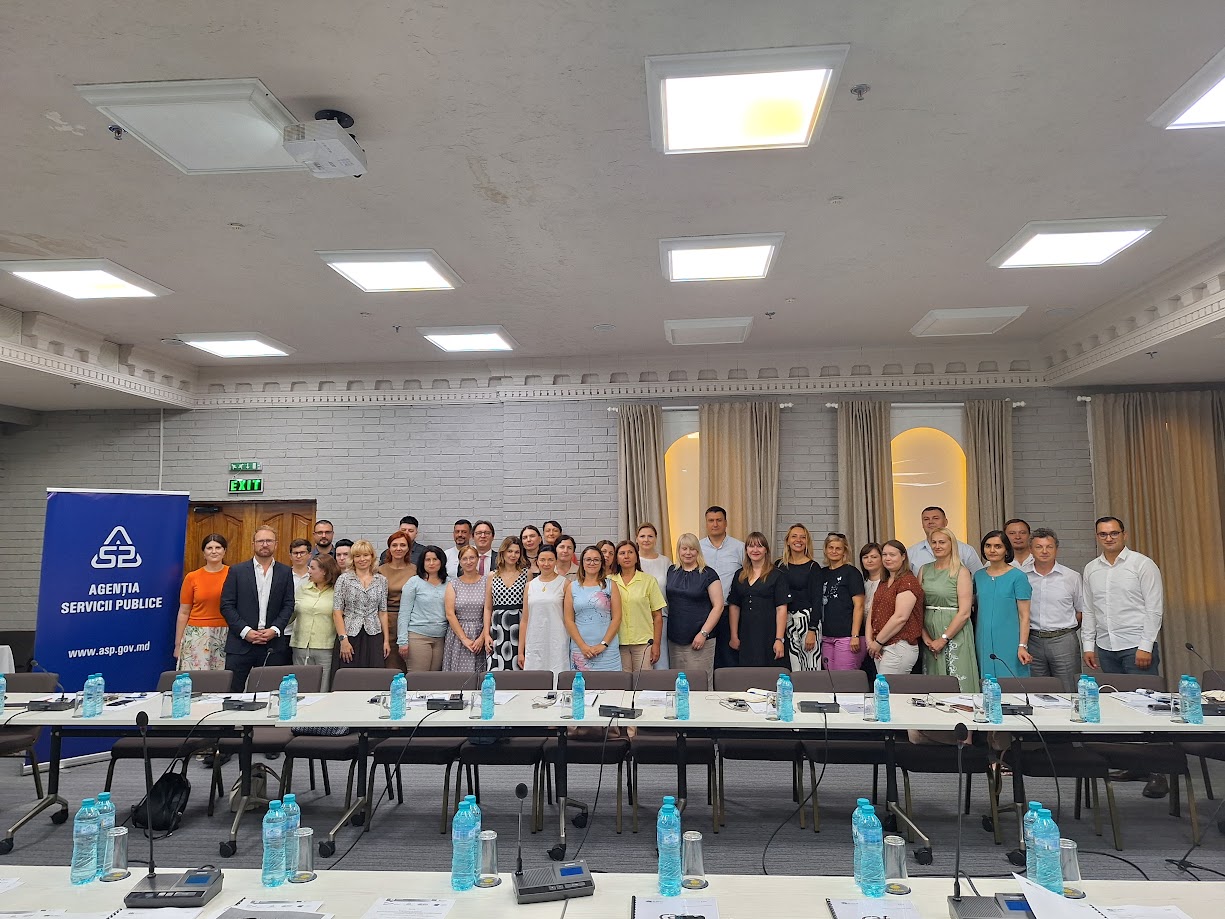
The programme of the experts’ working visit was comprehensive and included several activities. Thus, over the course of two days, a group of PSA employees participated in a training programme on the implementation of the CAF (Common Assessment Framework) quality management model, delivered by experts Nick Thijs and Tihana Puzić. The participants acquired not only theoretical knowledge but also important practical skills for applying the new quality management tool in their daily work.
On 4 July, the CAF model was presented at the thematic conference “Quality Management for Effective Public Administration Reform”, organised by the PSA. It provided a working platform for approximately 50 participants from the public sector, representing several public institutions: the State Chancellery, the Parliament of the Republic of Moldova, the Ministry of Finance, the Ministry of Economic Development and Digitalisation, and the National Accreditation Centre of the Republic of Moldova. The event addressed key topics related to improving quality in public administration, effective management strategies and how they can contribute to the implementation of ongoing reforms in the Republic of Moldova.